Rubbish Removals Waste: Our Recycling and Sustainability Commitment
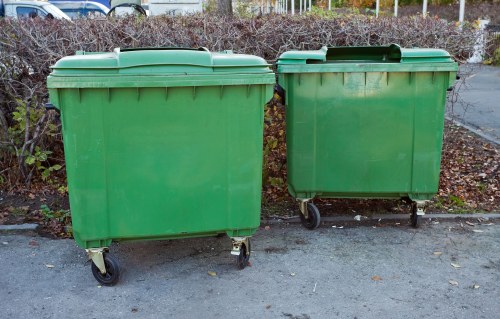 At Rubbish Removals Waste we believe that every tonne diverted from landfill is a win for the community and the climate. Our recycling percentage target is ambitious but achievable: we aim to achieve a 70% recycling and diversion rate across all collections and processing by 2028. This target applies to household-style clearances, commercial waste collection and specialised rubbish removal services across the boroughs we serve. We track progress monthly and publish summary impact updates so partners and residents can see how rubbish removals are becoming more sustainable.
We support local councils' approaches to waste separation — encouraging residents to use separate food caddies, mixed recycling bins and glass collections where available. By aligning our rubbish removal processes with borough collection schemes, we reduce contamination and increase the percentage of material that can be recycled. Our teams are trained to spot mixed loads and apply simple on-site segregation that helps local authority sorting facilities work more efficiently.
 Our network relies on strategic local transfer stations and material recovery facilities (MRFs) to keep waste moving away from landfill. We regularly use municipal transfer points such as the Northside Transfer Station and Riverbank MRF (names reflect local municipal facilities) as intermediate hubs, reducing haulage distance and splitting loads by type. These transfer stations allow us to segregate paper, cardboard, plastics, glass and metal more effectively, raising overall recycling yields for our rubbish removal operations.
How our waste removal and recycling works in your neighbourhood
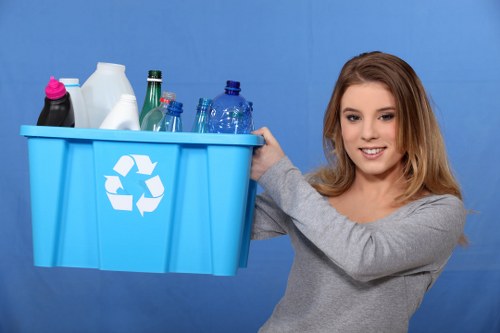 We operate a layered model: collection, transfer and processing. Collections are carried out by a mixed fleet that includes low-emission vans for tighter urban routes and larger trucks when needed. After collection, materials are taken to local transfer stations or partner MRFs so that recyclable streams are maximised before onward processing. This staged approach helps us hit targets for both rubbish removal services and long-term sustainability.
Our sorting practices reflect local borough policies: in some districts glass is collected separately, in others mixed recycling is standard. We work with local authorities to honour those systems and to ensure that household separation rules are mirrored in our commercial clearances. This coordination reduces contamination and improves the quality of materials that are ultimately recycled into new products.
We also prioritise resource recovery beyond traditional recycling. Items that are reusable are diverted to re-use channels rather than being processed as raw recyclables. That approach can double the environmental benefit of a single bulky-item collection, and reduces the carbon footprint of our rubbish removal operations.
Partnerships, charities and circular economy initiatives
Our community partnerships are central to our sustainability strategy. We collaborate with local charities, social enterprises and furniture re-use organisations to ensure good-quality items are redirected to people who need them. Partnerships include donations of working furniture to community centres, mattresses that meet safety standards to specialist re-use schemes, and textiles to local thrift charities. By building strong links we reduce waste and support social value.
Key elements of these partnerships include:
- Pre-check and triage — our crew identifies reusable items at collection and arranges transfer to charity partners.
- Collection scheduling — coordinated pick-ups reduce double-handling and lower transport emissions.
- Direct delivery — when appropriate, items are delivered directly to charity shops or community depots.
These initiatives are part of a circular approach to waste: keeping products in use for longer and avoiding high-energy recycling processes when simple reuse is possible.
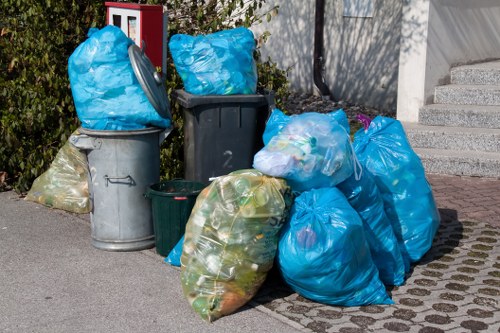 Low-carbon vans and smarter logistics play a major role in cutting emissions from rubbish removal. We have invested in a growing fleet of electric and hybrid vans for urban routes, complemented by diesel-electric trucks with the latest particulate filters for larger loads. Telematics and route-optimisation software reduce mileage and idling time; the result is lower fuel use and fewer emissions per job.
Operational improvements add up: consolidated collections, scheduled charity drop-offs and better load planning reduce the number of trips to transfer stations and MRFs. This lowers costs and delivers measurable carbon savings, moving us closer to our 70% recycling and diversion target while making our waste collection services cleaner and quieter in dense residential areas.
 Transparency and continuous improvement are woven into our approach. We publish annual sustainability results, including diversion rates, the tonnages sent to re-use partners and the proportion of collections completed with electric or low-emission vehicles. Our teams receive ongoing training in correct segregation, safe handling and identifying items suitable for charity donation — all to ensure that each rubbish removal is an opportunity to recover value and reduce environmental impact.
Rubbish Removals Waste is committed to being part of the solution: improving local recycling rates, strengthening transfer station partnerships, expanding charity collaborations and rolling out low-carbon vans. Together with residents, businesses and borough recycling programmes, we turn what was once waste into resources, jobs and community benefit.