Insurance and Safety for Rubbish Removals Waste
At Rubbish Removals Waste we place safety and insurance at the heart of every job. Our rubbish removals and waste clearance teams operate under a clear framework designed to protect clients, the public and our employees. Public liability insurance underpins every site operation and is complemented by robust staff training and well-documented site risk controls. We deploy experienced crews for domestic and commercial rubbish removal services and maintain a culture of continuous safety improvement.
Our approach to waste management and rubbish clearance ensures that every project begins with an assessment of legal obligations, the scope of work and site-specific hazards. This page outlines our commitments to insurance, employee training, personal protective equipment (PPE), and the risk assessment process that governs each job.
Public Liability Insurance: Coverage and Commitment
Rubbish removal services carry unavoidable risks — from slips, trips and falls to accidental property damage. To manage these exposures we maintain comprehensive public liability insurance that covers third-party injury and property damage arising from our operations. Our policy limits are designed to meet or exceed typical industry requirements for waste clearance projects and are reviewed annually. This insurance provides peace of mind for clients engaging our rubbish removal teams and forms part of our standard operating assurances.
Insurance is only one part of our protective strategy; it is supported by active controls that reduce claim frequency and severity. Where potential exposures are higher (for example, heavy or hazardous waste removal), we combine higher cover with enhanced controls such as restricted access zones and specialist subcontractors trained in hazardous waste handling.
Staff Training and Competency for Waste Removal
 Our workforce is the foundation of safe rubbish removals. Every operative completes a structured induction that covers manual handling, correct use of tools, safe lifting techniques and the identification of hazardous materials. Training programs include classroom learning, on-site mentoring and regular refresher courses. We document competencies and only assign personnel who are signed off as competent for specific tasks, such as bulky waste clearance, loft clear-outs, or commercial skip operations.
We use a blended training model: formal training sessions, practical demonstrations, and regular toolbox talks that address seasonal risks or site-specific issues. Supervisors hold additional training in supervision and incident management so they can maintain standards for every rubbish removal or waste disposal activity.
PPE Policy and Standard Protective Equipment
Personal protective equipment is mandatory on all sites where our rubbish removal crews operate. Our PPE policy ensures that team members are equipped for the hazards they will face and that replacements are readily available. Standard issued PPE includes:
- High-visibility jackets and vests to improve worker visibility near traffic or plant.
- Steel-toe safety boots for foot protection during heavy lift operations.
- Cut-resistant gloves and chemical-resistant gloves where applicable.
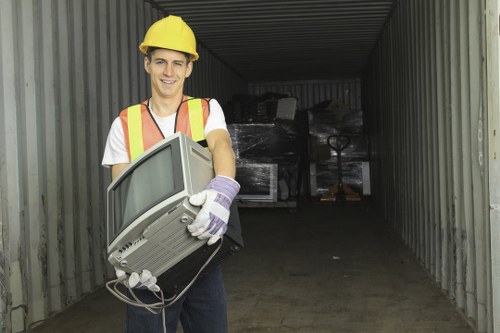
- Hard hats when working near overhead hazards or on construction-adjacent sites.
- Dust masks and respirators for dusty or contaminated environments.
We require crews to inspect PPE before use and to report damaged items for immediate replacement. PPE is selected following the risk assessment for each job so that the chosen equipment matches the specific hazards for that removal or clearance task.
Risk Assessment Process for Rubbish Removals and Waste Services
Every rubbish removal, whether a single-item pickup or a full property clearance, begins with a formal risk assessment. Our standard process is:
1) Site survey and hazard identification (static assessment).
2) Job-specific risk evaluation considering manual handling, traffic, and environmental risks.
3) Control measures selection — engineering controls, safe systems of work, PPE and exclusion zones.
4) Documentation and sign-off by the site supervisor.
5) Dynamic risk assessment during the job to address changing conditions.
Risk assessments are recorded and stored with job paperwork. For commercial or complex waste removal projects the assessments include traffic management plans, waste segregation protocols and arrangements for safe disposal of hazardous items in accordance with waste management regulations.
Safe systems of work derived from these assessments include lifting teams for heavy items, use of mechanical aids (trolleys, hoists), and clear delineation of public access routes to prevent incidents. We also maintain documentation to assist in insurance claims should an incident occur despite controls.
 We operate a clear incident reporting and investigation procedure. If an accident, near miss or damage occurs on a rubbish removal job, staff must report it immediately. Supervisors complete an incident form, preserve relevant evidence and implement corrective actions to prevent recurrence. Findings feed back into training and audits to drive continuous improvement across our rubbish removal and waste disposal services.
 In conclusion, our combined approach of adequate public liability insurance, comprehensive staff training, enforced PPE standards and a systematic risk assessment process creates a resilient safety framework for all rubbish removals and waste management activities. We are committed to protecting people and property while delivering efficient, compliant waste removal and rubbish clearance services. Safety is not an afterthought — it is built into every stage of our work, from booking through to completion, and reinforced by regular monitoring and review.